
Research within EEL focuses on why animals do the things they do. This means we study animal behaviour, and how it relates to ecological and evolutionary processes. We have a particular interest in social behaviour, so why two or more animals interact, what happens when they do so, and what consequences this has for their ability to respond to environment change and the evolution of populations. We often use social network analysis in our work, while increasingly we are using bioinformatic approaches to understand the genomic mechanisms underpinning phenotypes.
Our work can be grouped into two broad areas: Evolution when animals interact and Plasticity in response to environmental stress. Since we often use them in our research the lab is also interested in the Welfare of invertebrates.
Plasticity in response to environmental stress
Climates are changing rapidly, raising questions as to whether animals can cope. Social interactions are thought to help animals cope with stress (from the environment and elsewhere). One suggested solution is for them to flexibly change their behaviour as climates change, “buffering” any fitness loss. For example, we’ve shown dolphins become more gregarious in months of higher salmon abundance, but do not change other social phenotypes and do not respond to the North Atlantic Oscillation index. We’ve reviewed how social behaviours change in response to temperature, pollution, habitat fragmentation, and extreme events across taxa, and are suggesting some revisions to the “social buffering” framework.

Responses to environmental stress can be hard to spot, but we can use ‘omics technologies to measure changes in gene expression and epigenetic modification and so determine what organisms are up too. For instance, we’ve shown social spiders show limited changes in DNA methylation profile in response to infection, but there are some patterns in less-studied methylation contexts. Meanwhile, Hamish’s PhD project is looking at changes in gene expression and methylation when beadlet anemones are exposed to hydrocarbon pollution.
Evolution when animals interact
Normally we think that an organism’s genes influence its phenotype, and this phenotype influences its fitness. However, when animals interact, their genes can influence the phenotypes of others (known as “indirect genetic effects”) and their phenotypes can influence the fitness of others (known as “social selection”, and equivalent to W. D. Hamilton’s “benefits” of altruistic behaviours).
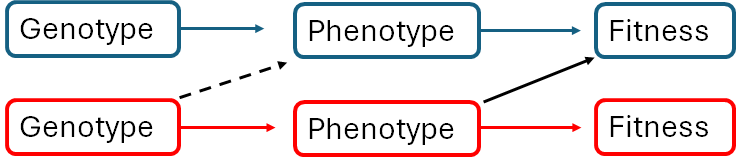
We have developed methods to measure indirect genetic effects in groups of animals who interact at different intensities, and applied that in North American red squirrels. We found that neighbours influence the breeding dates of each other, especially at high densities, but the genetic component to this was uncertain. We also found that dead squirrels can influence the (unrelated) individual that inherits their territory due to the large caches of cones they often leave behind. The fun is not limited to squirrels; in a recent meta-analysis we have shown that indirect genetic effects consistently impact phenotypes across all taxa, and especially so for behavioural and reproductive traits. We have also shown density dependent social selection in the charismatic New Zealand giraffe weevil, and we’re working on whether social selection shapes dolphin and cockroach social behaviour. A type of indirect genetic effect is “maternal effects”, the focus of PhD student Georgia’s project, while Jake’s PhD is looking at indirect genetic effects in rice – the world’s most important food crop.
Social interactions can mean evolution does strange things. We developed theoretical insights showing how social interactions can cause evolution to move in the opposite direction to direct selection, allow trait evolution and adaptation to be de-coupled, and allow maladaptation (where fitness evolves to be lower across generations, which previously was not thought to be compatible with evolutionary theory). We have also explored how the genes of others should often affect sociability and will always affect group size, meaning the latter is surprisingly evolvable. We’re planning to test these predictions in cockroaches in the EEL laboratory.

Welfare of Invertebrates
Given the trillions of invertebrates farmed for food and feed, and the uncounted numbers used in research, increased recognition of their sentience and requirement for welfare will be incredibly impactful. We have recently shown tagging cockroaches can alter their movement, demonstrated motivational trade-offs, a key indicator of the ability to feel pain, in cockroaches (in prep.), and are exploring whether cockroaches show affective states (something like emotions). We have also given a symposium talk on insect welfare, written a forum paper discussing when, if not now, we should start caring about insect welfare.
David has recently helped push for the increased recognition of insect sentience and pain as a member of the Insect Welfare Research Society, the Animal Welfare Research Network, and by signing the New York Declaration on animal consciousness, and has promoted spider conservation in the press. We are part of two EU COST actions (AFFECT-EVO & Insect-AMP) relevant to invertebrate welfare and sentience, so watch this space for more on this front!
 Evolutionary Ethology Lab